

Fiber optic and xDSL connections do not deliver the same performance: the differences are clear and directly impact everyday digital life. Speed, stability, and lower maintenance needs make FTTH networks a generation ahead of copper. Here are three reasons why it’s more reliable and ready to support the challenges of the future.
Today, ultra-fast connectivity is no longer a luxury but a daily necessity for institutions, businesses, and households. Studying, working remotely, handling administrative tasks online, or simply enjoying leisure activities all require a stable, high-performing network. The quality of the connection affects the ability to access and use increasingly advanced digital services.
Before the arrival of fiber optics, Italy’s network infrastructure relied for a long time on earlier technologies. Among these, the most widespread was the xDSL family of connections, which enabled millions of people to experience the internet revolution. While decisive in its time, this technology now shows its limits on a daily basis.
Fiber optics represent a true generational leap, designed to meet today’s demands and, above all, to grow with the needs of tomorrow. The technical differences compared to xDSL solutions are significant, covering crucial aspects that directly affect overall performance. Let’s take a closer look.
A First Look at Fiber Optics and xDSL
The term xDSL refers to a set of technologies based on Digital Subscriber Line (DSL), which uses copper telephone lines to deliver internet connectivity.
The best-known is ADSL, capable of reaching download speeds of a few dozen Mbps but with very limited upload capacity. Later came VDSL (also known as FTTC, Fiber To The Cabinet), which brings fiber to the street cabinet and uses copper only for the final stretch to the home. This solution is faster than ADSL, but performance drops sharply as the distance from the cabinet increases. There are also more symmetrical variants such as SHDSL, offering similar upload and download speeds, mainly for professional applications.
All xDSL technologies have one thing in common: copper. Originally designed for analog telephony based on electrical signals, copper was never intended for massive data transmission.
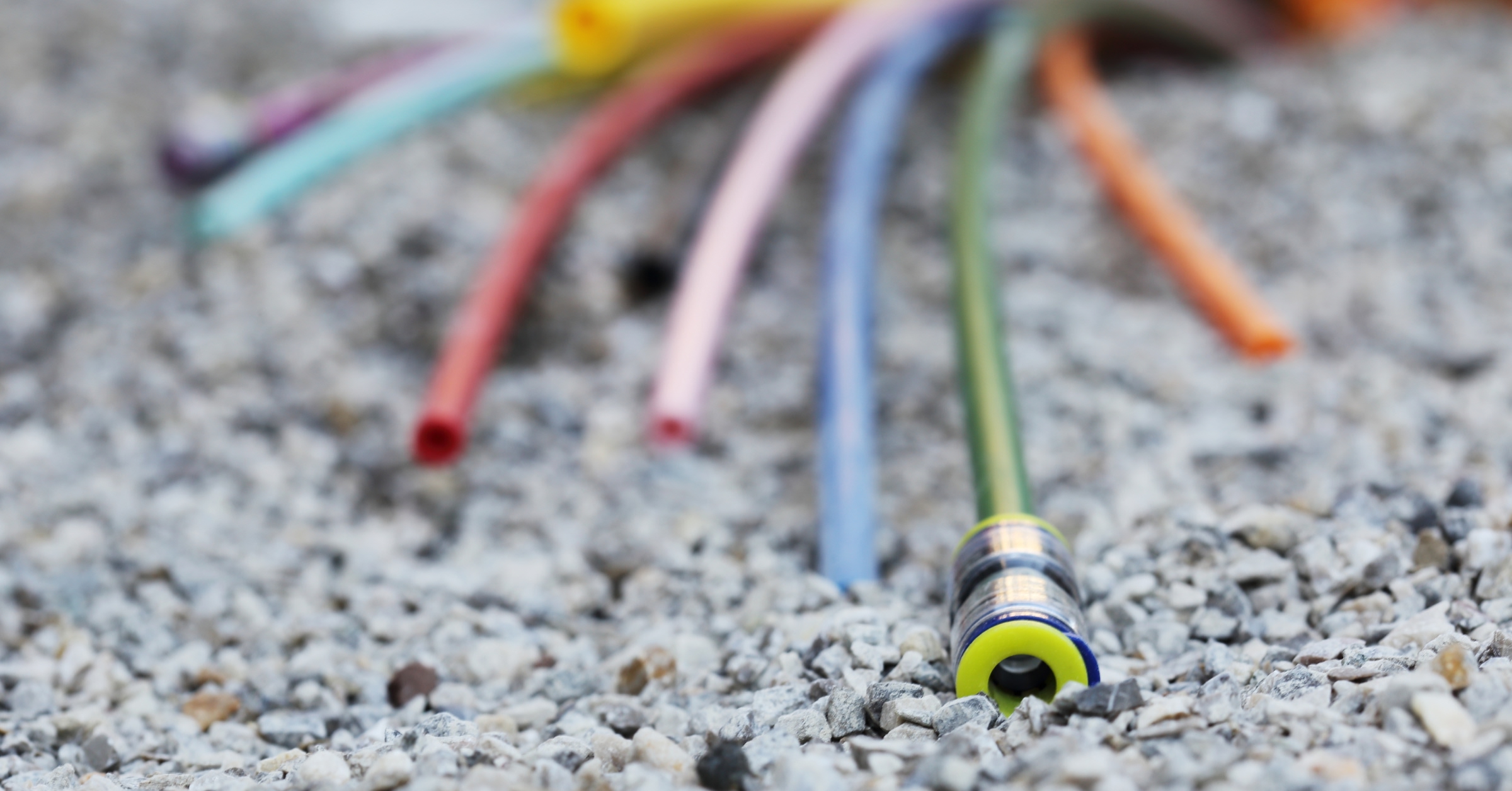
FTTH (Fiber To The Home) technology, on the other hand, uses glass fibers contained in thin plastic-coated cables to transmit light pulses. Light travels at extremely high speeds, free from electromagnetic interference, external conditions, or data loss. The entire infrastructure is fiber-based, with no copper segments: this ensures the highest performance.
In particular, FTTH networks will eventually support multiple access speeds (1G, 10G, 25G, 50G up to 100G) over a single fiber infrastructure. This makes it suitable for both public and private sectors, adapting to clients and services with different requirements.
Fiber optics also ensure greater energy sustainability: efficiency increases with usage, with significantly lower consumption per gigabit transmitted.
Fiber Optics vs. xDSL: A Side-by-Side Comparison
The structural difference between the two technologies is only one of the many elements distinguishing FTTH networks from xDSL connections, yet it remains key to understanding their technical features.
In this article, we focus on performance, analyzing why fiber optics are today the most effective and advanced solution to meet every connectivity need, from work to entertainment.
We’ll consider three key aspects: speed, stability, and maintenance.
Connection Speed: Fiber Optics vs. xDSL
The first major difference between fiber and copper lies in speed.
FTTH networks can reach up to 10 Gbps in both download and upload, and are fully scalable.
Such performance makes it the ideal technology for all ultra-broadband applications: streaming 4K and 8K content, high-quality video conferencing, smart working, and advanced technologies for businesses and institutions. For private users, ultra-fast connections will enable new frontiers of digital experiences such as immersive gaming, the metaverse, high-quality video streaming, and virtual reality.
xDSL networks, by contrast, cannot compete. ADSL reaches up to 24 Mbps in download and around 1 Mbps in upload, while the more advanced VDSL can achieve — under optimal conditions — 100 Mbps in download and 20 Mbps in upload. However, these values are not consistently stable over time.
Copper loses efficiency along the way, while fiber optics not only deliver higher nominal performance but also maintain it unchanged over long distances.
Stability: Fiber Optics vs. xDSL and the Role of Latency
An efficient internet connection must be not only fast but also stable and reliable, ensuring consistent performance without sudden drops or significant fluctuations.
A crucial parameter in assessing stability is latency, the delay between a user’s action (e.g., clicking a link or issuing a command in an online game) and the network’s response. Latency is measured in milliseconds and is influenced by technical and structural factors: the more complex and layered the network, the higher the response delay.
Fiber networks, thanks to their all-fiber structure, guarantee very low latency and therefore more stable connections. Response times remain optimal even when multiple devices are connected simultaneously or when the distance from the exchange is significant.
xDSL connections, on the other hand, face the typical limits of copper: higher and more variable latency, fluctuating bandwidth capacity, and a greater risk of congestion—especially during peak hours when many users share the network.
Network Maintenance: Fiber Optics vs. xDSL
Another fundamental aspect — often overlooked when comparing the two technologies — concerns long-term durability and network management.
Fiber optics are designed to last and support digital innovation over time. The special material used in fiber cables does not oxidize and is resistant to weather conditions. This means fewer faults, less maintenance, and consistently high performance even after years of use.
FTTH networks are also a sustainable choice. Once installed — with low-impact techniques — they can support ever-higher speeds without replacing the cables, simply by upgrading the electronic equipment at the ends.
Copper cables, typical of xDSL networks and originally designed only for voice transmission, degrade over time, are vulnerable to environmental conditions, and require regular checks and repairs. Technological upgrades are also limited: boosting performance means pushing an infrastructure never meant to handle large volumes of data.
Fiber optics are therefore a long-term solution: less maintenance means lower costs and reduced environmental impact, while copper becomes increasingly costly and fragile as years go by.
The FTTH Open Fiber Network Enables Innovation
The differences between fiber optics and xDSL are not just numbers: they are structural gaps that directly affect the quality of digital services we can access. FTTH networks are today the most modern, stable, and reliable infrastructure, ready to meet the technological challenges of the future.
For this reason, Open Fiber works every day to reduce the digital divide and, as a wholesale operator, to bring ultra-fast connectivity even to Italy’s so-called White Areas.
The goal is to give citizens, businesses, and public administrations access to cutting-edge digital services, accompanying Italy on its path of technological transformation and economic and social growth.
Don’t get left behind — find out if fiber optics have reached your area. Check your coverage now.