


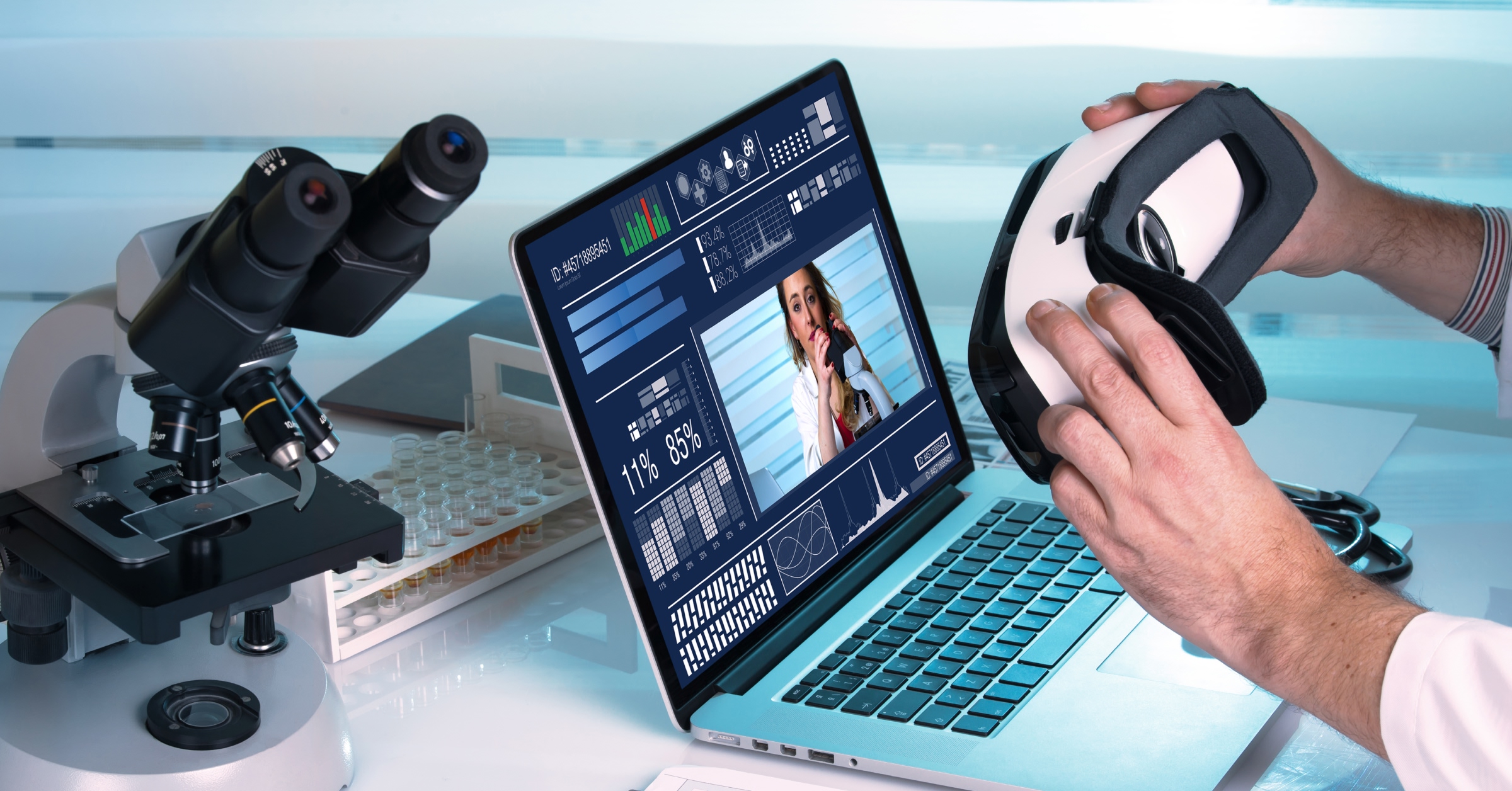
Augmented reality (AR) and virtual reality (VR) are transforming the way we work, learn, and collaborate. However, these immersive technologies can truly reach their full potential only if supported by network infrastructures capable of meeting their demands. In this context, FTTH (Fiber To The Home) fiber optics represents a key enabling factor.
Augmented reality and virtual reality are increasingly integrated technologies that are set to overlap across numerous contexts, including industrial, technical, and educational environments. This convergence makes it possible to enable various forms of remote collaboration without the need for physical travel or for people to be present in the same location, instead fostering real-time interactions between individuals who may be far apart. Immersive experiences, however, rely on the continuous transmission of large volumes of data, real-time synchronization, and high visual quality. Without a stable, fast, low-latency connection, the effectiveness of AR and VR is inevitably limited. This is precisely where the strategic role of fiber optics networks comes into play.
Immersive training and remote collaboration: the key role of connectivity
Augmented reality (AR) and virtual reality (VR) technologies are playing an increasingly important role in many areas of training, where they enable effective simulations, training activities, and updates on next-generation software. These are immersive digital environments, also suitable for high-risk activities, offering the advantage of being controlled and safe, reducing distractions and allowing participants to interact actively from remote locations.
A significant example is in medicine, particularly in surgery, where teams of doctors can follow procedures via tablets, smart glasses, or VR headsets, experiencing an immersive environment similar to an operating room while being physically elsewhere. In this way, expertise can be shared and complex procedures observed remotely, expanding learning and collaboration opportunities among professionals.
The education sector is also already benefiting from these technologies. Online institutions and universities, for example, are experimenting with the integration of advanced digital tools to enrich teaching and learning methods.
Distance learning saw a major acceleration during the COVID-19 pandemic, leading to widespread use of virtual classrooms as structured learning environments. In this context, online education has represented not only an emergency solution but also an opportunity to ensure greater continuity in learning, particularly for students with disabilities or those who, for specific reasons such as high-level sports commitments, cannot always attend classes in person.
Virtual classrooms, accessible via computers and other digital devices, have thus introduced more flexible and inclusive participation methods that continue to be adopted beyond the emergency phase. However, for these experiences to be smooth and truly immersive, it is essential to rely on a connection that guarantees high video quality. Without a high-performing network, the effectiveness of the learning experience itself may be compromised.
Industry 4.0: efficiency and innovation thanks to AR, VR, and fiber optics
In the context of Industry 4.0, AR and VR are revolutionizing both workforce training and production processes. Virtual simulations make it possible to test machinery, design prototypes, and train operators without the need for dedicated physical spaces or travel.
A technician can be guided remotely in real time while accessing information and instructions directly in the field through AR devices. Similarly, teams can collaborate remotely on shared virtual models.
Overall, the integration of AR and VR into industrial processes can help reduce the risk of operational errors, improve procedural efficiency, and contain unexpected costs. At the same time, the ability to quickly access real-time data and information directly during work activities represents one of the most significant opportunities these technologies offer for the evolution of the economic and production landscape.
Here too, however, network quality is crucial: low latency, high transmission capacity, and connection stability are essential requirements to avoid interruptions, delays, or data loss. Fiber optics thus becomes a key factor in improving efficiency, reducing errors, and controlling operational costs.
Open Fiber and its FTTH fiber optics for AR and VR
In Italy, Open Fiber is among the key players in the development of FTTH networks, designed to provide ultra-high-speed, low-latency connections.
The characteristics of Open Fiber’s fiber optics – such as the ability to transmit large volumes of data in a stable and continuous way – are essential for advanced immersive applications. FTTH networks can reach speeds of up to 10 Gbps, both in download and upload, making it possible to enjoy complex and interactive content without compromise.
AR and VR are not simply innovative technologies, but tools that require a solid infrastructure to perform at their best. Without a high-performing network, immersive experiences risk being incomplete or ineffective.
For this reason, the widespread adoption of fiber optics represents a crucial step for the large-scale development of immersive applications in education, healthcare, industry, and remote collaboration. Check whether your address is covered by Open Fiber’s fiber optics.