Open Fiber is developing modern national transport infrastructure that will collect traffic from the FTTH access network and deliver it to operators, ensuring equal access and service conditions regardless of the point of delivery, whether local or remote.
In this sense, the network enables the provision of a comprehensive portfolio of services to meet the needs of an increasingly diverse market, from end-to-end connectivity with guaranteed bandwidth and controlled latency to the future provision of a network and computing infrastructure to host third-party physical and virtual functions; all aimed at enhancing customers’ Quality of Experience, supporting the delivery of high-resolution video content, offering security solutions and platforms for Internet of Things (IoT).
Open Fiber has a transport network with open, carrier-grade architecture, which is programmable, high-performance and scalable in capacity, enabling Operators to deliver innovative ultra-broadband services, simplifying configuration and management tasks.
For the configuration and management of transport services, Open Fiber uses innovative Network Automation techniques that implement automated workflows, which take the work order from the CRM and activate it in the network, speeding up the time for the release of new services and reducing the possibility of errors, thereby improving the Quality of Experience perceived by customers.
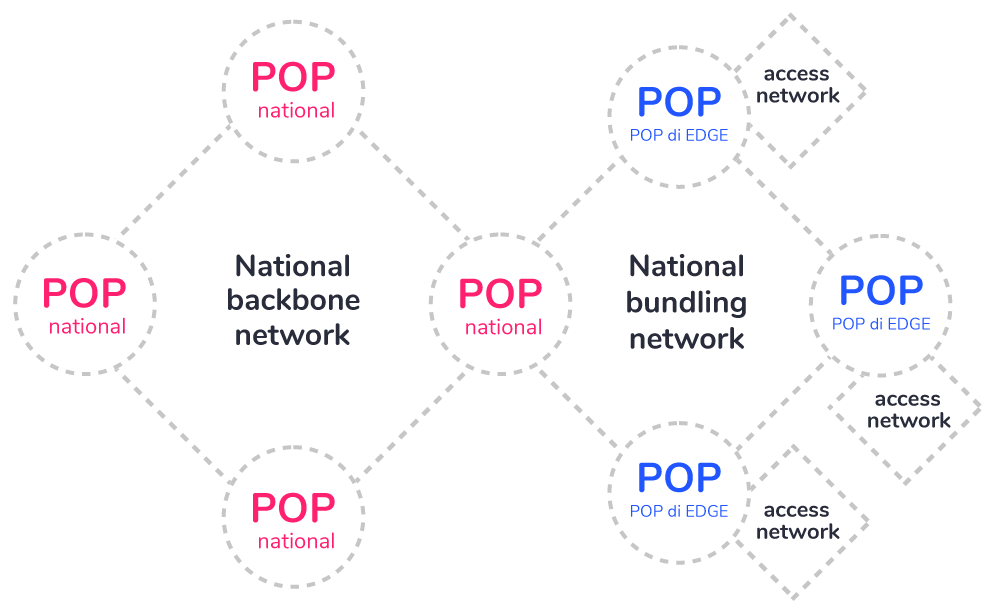
Open Fiber’s Transport Network consists of just two levels:
● a national core or backbone network
● an aggregation network (primary and secondary)
The design of the national backbone is based on two domains: an optical domain (OTN/WDM) to handle transmission with the most efficient and least costly techniques and an electrical domain (IP/MPLS) for processing and routing packet traffic. It ensures optimal utilisation of valuable transmission resources, quality of service implemented across the entire chain, flexibility and process automation to quickly deliver traditional and innovative services.
National PoPs are distributed in a way that ensures full coverage of the entire country and features very high-capacity optical links (coherent 100/200G lambda).
The backbone network is created using an intelligent, high-capacity, scalable DWDM (Dense Wavelength Division Multiplexing) EON (Elastic Optical Network). ROADM-FLEX (Reconfigurable Optical Add and Drop Multiplexer) multi-degree and GMPLS/WSON (CD – Colourless, Directionless) technologies are used, with which several optical channels can be simultaneously aggregated on a single fibre and therefore handle more and more customers and services, making it possible to fully utilise the very high transmission bandwidth of the fibre, in the Terabit range (1,000,000 Megabits). This capacity, which was unimaginable until a few years ago, will support the ultra-broadband applications that will be developed in the coming years (high-resolution video, virtual reality, augmented reality, haptic Internet, real-time gaming, autonomous driving) and in general the innovative services of future 5G networks. The aggregation network, formed of Edge’s PoPs and with high-capacity optical links, offers Layer 2 functionality as well as MPLS protocol support where necessary, to deliver the wholesale services required by Operators.