

Fiber doesn’t just deliver speed: it brings people and services closer together, creates new opportunities for businesses, and contributes to the development of cities, small towns and inland areas. This is where Open Fiber’s story begins – the company took part in the 47th edition of the Meeting for Friendship Among Peoples in Rimini, held from August 21 to 26, 2026.
A network enters buildings and reaches all the way into homes. Even though we don’t see it, it’s what makes many of our everyday activities possible – working remotely, studying online, accessing digital services, innovating a business, or building new projects even far from major urban centers.
And behind each of these possibilities lies fiber optics technology, which Open Fiber showcased during its presence at the Rimini Meeting, taking center stage in discussions dedicated to the future of cities and inland areas.
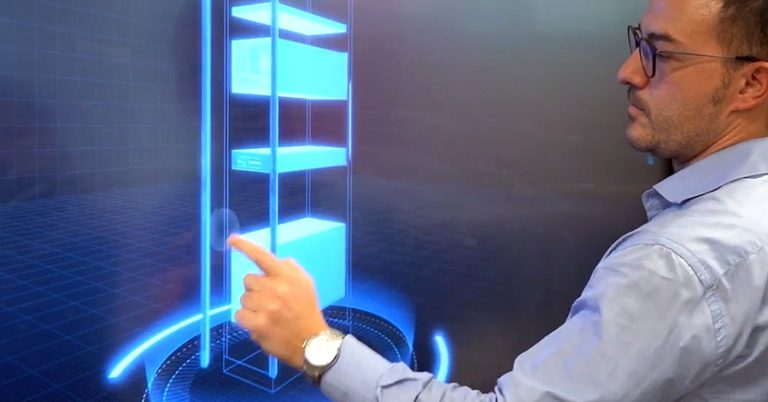
It was an opportunity to discover up close the advantages of the FTTH network, thanks in part to the Fiber Life Experience and the Open Fiber Condominium, created with YouStart to immersively showcase the opportunities enabled by connectivity.
Because a network can bring people, businesses, services and communities together.
Fiber optics reshapes cities
Building cities doesn’t simply mean constructing new spaces. It means envisioning places capable of adapting to people’s needs, offering increasingly accessible services, and creating new forms of participation, work and development.
This awareness was also something Open Fiber conveyed at the Meeting, through the address by Fabrizio dell’Orefice, Open Fiber’s External Relations Director, at the panel “Fare ancora città” (“Still Building Cities”), bringing the company’s perspective on the role of digital infrastructure in urban transformation.
It was a discussion that looked at the future of urban spaces and the role infrastructure can play in their evolution. Because today’s cities also come alive thanks to increasingly solid, digitalized infrastructure, and a stable, high-performing connection makes it possible to use services and support the growth of businesses.
That’s why ultra-broadband can today be defined as the backbone on which to build the city of the future. Not the endpoint of digital transformation, but what makes its development possible.
FTTH fiber and new opportunities for inland areas
The presence of an FTTH network in an area has, in many cases, changed the way people experience it. It’s in small towns and inland areas, in fact, that connectivity has helped redefine the very meaning of distance.
Living many kilometers from a major city no longer necessarily meant being far from work, education, services or opportunities. Wherever adequate digital infrastructure arrived, part of that distance was overcome thanks to an ultra-fast connection.
In these places, the spread of ultra-broadband has become a tool for supporting new ways of working, facilitating access to digital services and, above all, sustaining local economic activity, creating more favorable conditions for those who have chosen to live and invest in the area. The point, then, wasn’t just to bring a faster connection where one was previously missing, but to open up new possibilities, enabling quick access to services for all citizens. Open Fiber’s FTTH network has reached many Italian municipalities, building 168,277 km of infrastructure and connecting 17.443 million real estate units with fiber optics, spanning homes, businesses and public administration offices.
From Borgorose to Genoa: stories from connected territories
Contact with local communities is the most authentic testimony to what it really means to be connected. It’s the stories of those who have seen the FTTH network arrive – in Borgorose, Beltiglio, Cetara, Genoa – that convey the value of this technology better than any number could.
In Borgorose, a municipality in the province of Rieti, the arrival of fiber optics opened up new opportunities: the technology met a part of Italy’s inland areas, becoming part of a journey built on new possibilities. Fleet Support, for example, brought one of its two operational offices to the town, creating new jobs and new energy for the area. In Beltiglio too, a hamlet in the municipality of Ceppaloni, the arrival of Open Fiber’s ultra-fast connection brought new opportunities for work, education and economic development.
And again, in Genoa, where thanks to the Chiossone Foundation, ultra-broadband brings telemedicine through AVDesk technology, supporting citizens and various rehabilitation programs. Remote check-ups for rehabilitation, inclusion and health are thus made possible by the presence of an effective, reliable connection.
Different stories, different places, but a single underlying message: when the connection arrived, its value was measured above all in the opportunities it was able to generate – not just in Gbps.
Discover them in the “Connessi” (“Connected”) format: a space dedicated to the testimonies of those who live, work and innovate in the areas reached by fiber optics, telling – one story at a time – how connectivity is changing the face of the country.
“Fiber Life Experience”: fiber optics up close
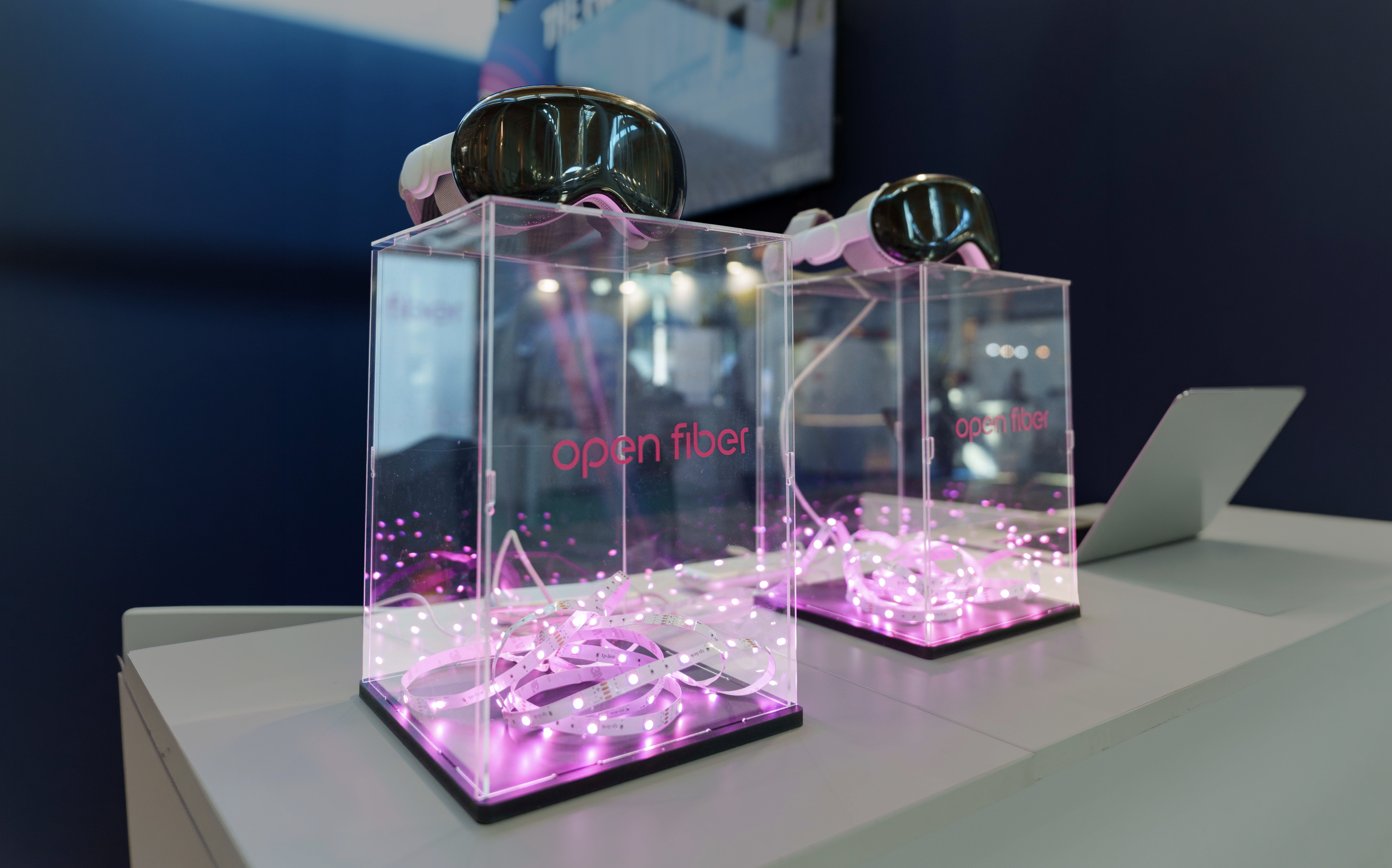
But how do you tell the story of something that remains invisible most of the time? Throughout the Rimini Meeting, the Open Fiber stand in the South Hall tried to answer that question through a hands-on experience.
Because behind a fiber optics cable there could be a student attending a remote lesson, a business using new digital services, or an organization that finds in technology a tool for inclusion.
This story was brought to life by the “Fiber Life Experience”, an immersive virtual reality experience created through the collaboration between Open Fiber and YouStart, a studio specializing in the design of immersive environments. Using Apple Vision Pro headsets, visitors entered a digital residential environment, discovering up close how this technology enables everyday activities such as smart working, remote learning, telemedicine, entertainment and home automation.
The experience also extended to an outdoor area, designed to showcase the network’s value for territories, communities and public administrations, from environmental monitoring to urban security. The stand thus became a space for moving from infrastructure to its concrete effects: not just seeing the network, but seeing what the network makes possible.
Connecting territories, from cities to small towns
A changing city and a small town seeking new opportunities may seem like two distant realities. Yet, faced with digital transformation, they share the same need: being able to rely on infrastructure capable of supporting their development. This is where cities and inland areas meet again.
Connectivity doesn’t erase the differences between territories, nor does it single-handedly resolve the economic and social challenges they face. However, it helps create a common foundation on which to develop services, innovation and new opportunities. From the panel dedicated to cities, to the discussion on the future of inland areas, to the stories told at the stand, Open Fiber’s presence at the Rimini Meeting followed a single thread: starting from the network to reach people, communities and territories.
Because connecting a place means, above all, opening it up to new possibilities. Want to find out if you’re connected? Check your address’s coverage now and see if Open Fiber’s FTTH fiber is available in your area.